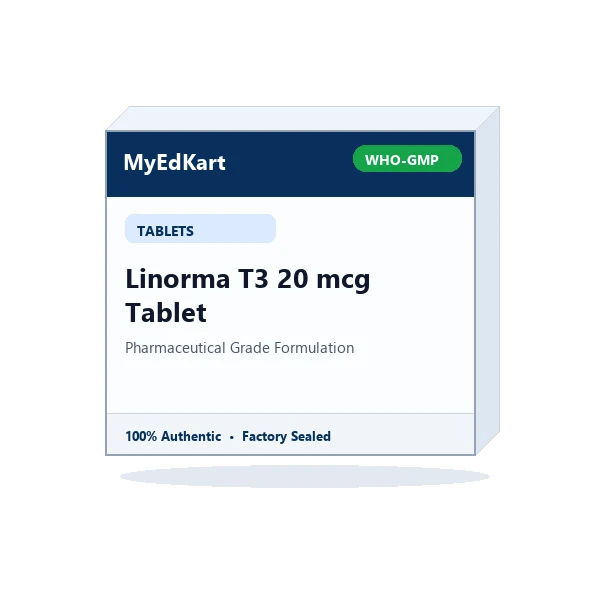
1. Description of Linorma T3 20 mcg
Linorma T3 20 mcg Tablet is a prescription thyroid hormone replacement medicine used to manage Hypothyroidism or an underactive thyroid. It contains 20 mcg of Liothyronine, a synthetic form of the natural Triiodothyronine (T3) hormone. Liothyronine is an FDA-approved active ingredient. Abbott India Ltd manufactures Linorma T3 in accordance with GMP requirements.
Liothyronine enters body cells and binds to thyroid hormone receptors that regulate energy use, metabolism, body temperature, digestion, and heart function. By replacing insufficient T3, Linorma T3 helps manage tiredness, cold sensitivity, constipation, slowed thinking, and other symptoms caused by low thyroid hormone levels. Doctors can also use Liothyronine for TSH suppression in selected thyroid cancer patients and during thyroid suppression testing.
The Linorma T3 20 mcg Tablet dosage is individualized based on thyroid test results, age, symptoms, heart health, and other medications. It is commonly taken once daily, but the exact dose and schedule must come from a doctor. Take it consistently with meals to maintain stable absorption.
If a dose is missed, take it when remembered unless the next dose is close. Never take two doses together. An overdose can cause severe nervousness, tremors, sweating, chest pain, rapid or irregular heartbeat, confusion, seizures, or loss of consciousness. Seek urgent medical help in such cases.
Common side effects include headache, anxiety, sleeplessness, sweating, tremors, diarrhea, heat intolerance, and palpitations. Get immediate help for chest pain, breathing difficulty, fainting, or a severely irregular heartbeat.
Inform the doctor about heart disease, Diabetes, adrenal problems, bone loss, pregnancy, breastfeeding, and all current medicines. Linorma T3 must not be used for Obesity or weight loss.
Store it at room temperature in its original packaging, protected from light, heat, moisture, children, and pets.
Linorma T3 and Cytomel both contain Liothyronine Sodium, the same FDA-approved synthetic T3 hormone used to replace low thyroid levels. Both work by binding to thyroid receptors and supporting normal metabolism. Cytomel is the original branded Liothyronine medicine, while Abbott India Ltd manufactures Linorma T3 as a cost-effective alternative.
Major differences include manufacturer, packaging, tablet appearance, inactive ingredients, availability, and price. These differences do not change Liothyronine’s intended action, but dose conversion must be handled by a doctor.
Take the missed Linorma T3 dose when you remember it. However, skip it if the next scheduled dose is close and continue with your regular routine. Do not take two doses together because excessive Liothyronine can cause palpitations, sweating, nervousness, and tremors.
2. How Linorma T3 20 mcg Works
Linorma T3 20 mcg Tablet replaces T3 when the thyroid gland does not produce enough hormone. Doing this provides the following benefits.
- Restores low T3 levels: Liothyronine provides active thyroid hormone directly to correct thyroid hormone deficiency.
- Improves Hypothyroidism symptoms: Regular treatment can reduce tiredness, cold sensitivity, constipation, weakness, slowed thinking, and poor concentration.
- Supports normal metabolism: Healthy T3 levels help regulate energy use, body temperature, digestion, heart activity, and other essential body functions.
- Supports selected thyroid procedures: Specialists can use Liothyronine for TSH suppression in certain thyroid cancer patients or as part of a thyroid suppression test.
Linorma T3 controls low thyroid hormone levels but does not cure the underlying thyroid condition. Continued treatment and regular thyroid blood tests are often required.
Linorma T3 20 mcg Tablet begins working within a few hours of consumption. Liothyronine is rapidly absorbed and reaches peak blood levels around 2 to 4 hours after an oral dose.
Early improvements in energy, mental clarity, and tiredness can become noticeable within 3 to 10 days. Changes in mood and other Hypothyroidism symptoms often appear within 1 to 2 weeks, while the full therapeutic response and stabilization of thyroid test results generally take 2 to 4 weeks.
Food can affect thyroid hormone absorption, so take Linorma T3 consistently in relation to meals. Individual response can vary according to the dosage, severity of Hypothyroidism, age, heart health, other medicines, and treatment consistency.
Consult a healthcare professional for personalized guidance on timing.
Consult a healthcare professional before taking Linorma T3 20 mcg Tablet. Follow the prescribed dose and attend all scheduled thyroid blood tests.
- Take Linorma T3 once daily or according to the exact schedule advised by your doctor, preferably at the same time each day.
- Swallow the tablet whole with water and take it consistently before, with, or after food according to your doctor’s instructions.
- Keep at least a 4-hour gap from bile acid sequestrants or other medicines that reduce thyroid hormone absorption when advised.
- Do not increase, reduce, combine, or stop the dose without medical guidance. Never double the dose after missing a tablet.
Linorma T3 starts acting within a few hours and reaches its maximum pharmacological response within 2 to 3 days. Improvement in tiredness, cold sensitivity, constipation, or slowed thinking can take several days or weeks, depending on the dosage and severity of Hypothyroidism.
Store Linorma T3 at room temperature in a cool and dry place. Keep the tablets inside their original packaging and protect them from direct sunlight, excessive heat, and moisture. Always store the medicine away from children and pets.
3. Mechanism of Action
At the cellular and biochemical level, Liothyronine (T3) interacts selectively with specific physiological receptors and enzymatic pathways responsible for regulating targeted therapeutic pathways.
By modulating these targeted pathways, Linorma T3 20 mcg restores balanced physiological response without unnecessary systemic burden when taken at the physician-recommended dose.
4. Dosage and Administration of Linorma T3 20 mcg
4.1 Recommended Dosage
The standard medical recommendation for Linorma T3 20 mcg Tablet is tailored according to patient tolerance, therapeutic response, and clinical evaluation. Always adhere to professional healthcare provider recommendations to minimize adverse events.
4.2 How to Take
- Swallow the tablet or capsule whole with a full glass of plain water.
- Can be taken with or without food, unless advised otherwise by your doctor.
- Avoid heavy, high-fat meals immediately prior to consumption for optimal absorption.
- Do not crush, chew, or split the tablet unless specifically designed as chewable or dispersible.
4.3 When to Take
Take Linorma T3 20 mcg strictly according to the schedule prescribed by your healthcare provider. Do not exceed more than one prescribed dose within a 24-hour window.
4.4 Who Can Use
✔ Suitable For:
- Adult patients diagnosed with conditions requiring Liothyronine (T3).
- Individuals evaluated by a licensed healthcare provider for Shop All Medicines therapy.
- Patients with verified tolerance to the prescribed strength.
✖ Not Suitable For:
- Individuals with known hypersensitivity or allergy to Liothyronine (T3).
- Patients taking contraindicated or interacting therapies without physician approval.
- Patients with unstable cardiovascular, severe hepatic, or renal conditions unless cleared by a specialist.
- Pediatric patients under 18 years unless explicitly prescribed.
5. Side Effects and Warnings
While Linorma T3 20 mcg is clinically evaluated and well-tolerated, systemic physiological responses may vary:
Linorma T3 20 mcg Tablet may cause side effects when you first start taking it. They do not usually require medical attention and will resolve as you adjust to the medicine.
Common side effects include:
- Headache
- Irritability
- Sleeplessness
- Tremors
- Excessive sweating
- Heat intolerance
- Increased appetite
Consult a doctor if these effects persist or become worse.
6. Precautions & Drug Interactions
Liver Disease
Linorma T3 20 mcg Tablet should be used carefully in people with Liver Disease. The liver helps process thyroid hormones, and severe liver dysfunction can affect hormone levels and the interpretation of thyroid test results. Consult a doctor for effective treatment.
Kidney Impairment
People with Kidney Impairment should use Linorma T3 under medical supervision. Thyroid hormones and their metabolites are partly eliminated through the kidneys, while kidney disorders can also change thyroid hormone-binding proteins. The doctor can adjust treatment according to symptoms, kidney function, and thyroid test results.
Pregnant and Breastfeeding women
Pregnant women should not stop medically necessary thyroid replacement without consulting a doctor. Untreated Hypothyroidism can affect both the mother and baby, while thyroid hormone requirements can change during pregnancy. Regular thyroid testing is essential. Liothyronine can pass into breast milk. Breastfeeding women should use Linorma T3 only after a doctor evaluates the treatment need and recommends a suitable dosage.
Avoid
Avoid Linorma T3 if you are allergic to Liothyronine or any tablet ingredient. Do not take it if you have untreated adrenal insufficiency because thyroid hormone treatment can trigger a life-threatening adrenal crisis. Never use Linorma T3 for weight loss, bodybuilding, or improving metabolism in people with normal thyroid function. Excessive doses can cause severe or fatal heart-related toxicity.
People allergic to Liothyronine or those with untreated adrenal insufficiency should avoid Linorma T3. Anyone with Hyperthyroidism, serious heart disease, Diabetes, clotting disorders, or severe bone loss should consult a doctor before treatment. It must not be used for weight loss.
7. Storage and Handling
Store Linorma T3 20 mcg Tablet blister packs at controlled room temperature between 15°C to 30°C (59°F to 86°F). Keep protected from excessive heat, bathroom moisture, and direct sunlight. Retain in original factory packaging until consumption and keep strictly out of reach of children and pets.
8. Frequently Asked Questions (FAQs)
Q: What is the active ingredient in Linorma T3 20 mcg?
A: Linorma T3 20 mcg is formulated with Liothyronine (T3) as its active pharmaceutical ingredient and is manufactured in WHO-GMP certified pharmaceutical facilities.
Q: How should I store Linorma T3 20 mcg safely?
A: Keep the medicine in its original moisture-resistant blister pack at room temperature (15°C–30°C), away from direct sunlight and out of reach of children.
Q: Can I order Linorma T3 20 mcg with discreet international shipping?
A: Yes. MyEdKart ships all orders in plain, tamper-evident packaging with live tracking numbers provided upon dispatch.
Q: Can Linorma T3 be combined with another thyroid medicine, such as Levothyroxine, when an endocrinologist specifically recommends it?
A: Yes, Linorma T3 can be combined with another thyroid medicine, such as Levothyroxine, when an endocrinologist specifically recommends it. Do not combine or switch thyroid hormones yourself because T3 and T4 medicines differ in strength, onset, duration, and dosage requirements.
Q: Should Linorma T3 20 mcg Tablet be taken with food or on an empty stomach?
A: No, taking Linorma T3 on an empty stomach is not always required. However, food can influence thyroid hormone absorption. Take the tablet in the same relation to meals each day and follow the timing recommended by your doctor for consistent thyroid levels.
Q: Can Linorma T3 be used long-term when thyroid replacement is medically required and regularly monitored?
A: Yes, Linorma T3 can be used long-term when thyroid replacement is medically required and regularly monitored. Treatment can be lifelong for some patients. Periodic thyroid tests, heart assessment, and bone health monitoring help prevent under-treatment or excessive thyroid hormone exposure.