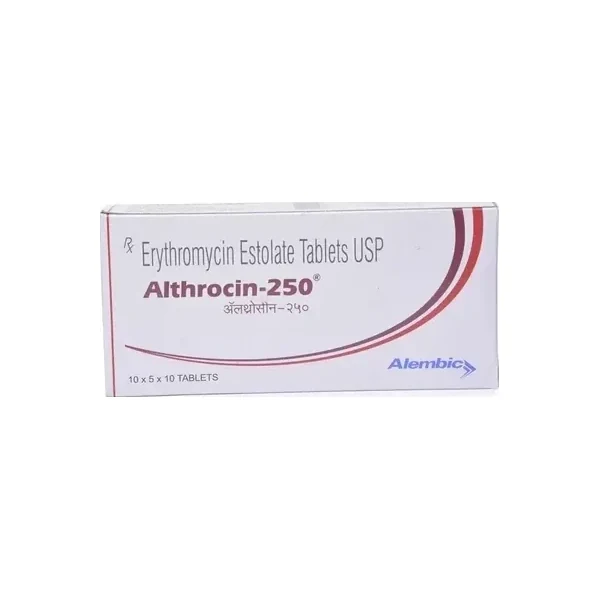
1. Description of Althrocin 250 mg
Althrocin-250 is marketed globally by Alembic Pharmaceuticals and is available at every leading online pharmacy, drugstore and medical supply store.The active ingredient present in Althrocin-250 is Erythromycin. It is used in the treatment and prevention of various bacterial infections.
Althrocin-250, that contains 250 mg of Erythromycin Estolate is manufactured by Alembic Pharmaceuticals.
- E.E.S. 400
- E.E.S. Granules
- Ery-Tab
- EryPed 200
- EryPed 400
- Erythrocin Lactobionate
- Erythrocin Stearate
- PCE
- Uses of Erythromycin, The Salt In Althrocin-250
- Urogenital infection: An infection of both, the urinary system and genital system
- Community-acquired pneumonia: Pneumonia contracted by a person with little contact with the health care system
- Impetigo: A contagious bacterial skin infection forming pustules and yellow crusty sores
- Pertussis (Whooping cough): A highly contagious respiratory tract infection
- Pharyngitis: An inflammation of the back of the throat, known as pharynx
- Tonsillitis: An inflammation of the two oval-shaped pads at the back of the throat, known as tonsils
A missed dose should be taken as soon as you remember it. However, if it is almost time for the next dose, skip the missed dose and go back to your regular schedule. Do not take multiple doses at the same time
The following drugs are known to interact with Erythromycin-
- Alprazolam
- Avanafil
- Bromocriptine
- Budesonide
- Calcium Channel Blocker
- Carbamazepine
- Cisapride
- Clindamycin
- Conivaptan
- Dabigatran Etexilate
- Domperidone
- Doxorubicin
- Edoxaban
- Eplerenone
- Fluconazole
- Ivabradine
- If you are allergic to erythromycin or to any other component of this drug.
- If you are allergic to similar drugs or any drugs in general, food items or any other substances. Inform your physician about the allergy and the allergic reactions (rash, itching, shortness of breath wheezing cough, swelling of face, lips tongue or throat, etc.)
- If you have any of the following problems: Long QT on ECG, low magnesium levels, or low potassium levels.
- If our heartbeat is slow, consult your doctor.
- If you take any drugs (prescription or OTC, natural products, vitamins) that must not be taken with this drug, like certain drugs that are used for mood problems, a heartbeat that is not normal, or migraine headaches.
- Get medical help right away if your heartbeat does not feel normal.
- Get medical help right away if you have signs like red, swollen, blistered, or peeling skin (with or without fever); red or irritated eyes; or sores in your mouth, throat, nose, or eyes.
- It is common to have diarrhea when taking this drug. Call your doctor right away if you have stomach pain or cramps, very loose or watery stools, or bloody stools. Do not try to treat loose stools without first checking with your doctor.
2. How Althrocin 250 mg Works
The drug acts by inhibiting the RNA-dependent protein synthesis at the chain elongation step; binding to the 50S ribosomal subunit resulting in blockage of transpeptidation.
- Use this drug as advised by your doctor. Read all the information given to you. Follow all instructions closely.
- To gain the most benefit, do not miss doses.
- Keep taking this drug as you have been told by your doctor or any other health care provider, even if you feel well.
- Take this drug at the same time of the day.
- Can be taken with or without food. However, It is advised to take it with food if it causes an upset stomach.
It is always advisable to consult your physician before you start/stop taking the drug. Avoid taking such decisions on your own and do not self-medicate.
3. Mechanism of Action
At the cellular and biochemical level, Erythromycin interacts selectively with specific physiological receptors and enzymatic pathways responsible for regulating targeted therapeutic pathways.
By modulating these targeted pathways, Althrocin 250 mg restores balanced physiological response without unnecessary systemic burden when taken at the physician-recommended dose.
4. Dosage and Administration of Althrocin 250 mg
4.1 Recommended Dosage
The standard medical recommendation for Althrocin 250 mg Tablet is tailored according to patient tolerance, therapeutic response, and clinical evaluation. Always adhere to professional healthcare provider recommendations to minimize adverse events.
4.2 How to Take
- Swallow the tablet or capsule whole with a full glass of plain water.
- Can be taken with or without food, unless advised otherwise by your doctor.
- Avoid heavy, high-fat meals immediately prior to consumption for optimal absorption.
- Do not crush, chew, or split the tablet unless specifically designed as chewable or dispersible.
4.3 When to Take
Take Althrocin 250 mg strictly according to the schedule prescribed by your healthcare provider. Do not exceed more than one prescribed dose within a 24-hour window.
Dosage
Erythromycin, the salt in Althrocin is available as 250 mg, 333 mg, 400 mg and 500 mg tablets, at every leading online pharmacy, drugstore and medical supply store.
Overdose of Althrocin-250
- Diarrhea
- Upset stomach
- Hearing loss
- Irregular heartbeat
4.4 Who Can Use
✔ Suitable For:
- Adult patients diagnosed with conditions requiring Erythromycin.
- Individuals evaluated by a licensed healthcare provider for Antibiotics therapy.
- Patients with verified tolerance to the prescribed strength.
✖ Not Suitable For:
- Individuals with known hypersensitivity or allergy to Erythromycin.
- Patients taking contraindicated or interacting therapies without physician approval.
- Patients with unstable cardiovascular, severe hepatic, or renal conditions unless cleared by a specialist.
- Pediatric patients under 18 years unless explicitly prescribed.
5. Side Effects and Warnings
While Althrocin 250 mg is clinically evaluated and well-tolerated, systemic physiological responses may vary:
- An allergic reaction, like a rash, hives, itching, red, swollen, blistered, or peeling skin with or without fever, wheezing, tightness in the chest or throat, trouble breathing or talking, unusual hoarseness, swelling of the mouth, face, lips, tongue, or throat.
- Signs of liver problems like dark urine, feeling tired, not hungry, upset stomach or stomach pain, light-colored stools, throwing up, or yellow skin or eyes.
- Not able to pass urine or change in how much urine is passed.
- Signs of pancreatic problems (pancreatitis) like unusually bad stomach pain, an unusually bad back pain, an upset stomach or throwing up.
- Seizures.
6. Precautions & Drug Interactions
- If your symptoms or health problems do not get better or if they become worse, call your doctor.
- Do not share your drugs with others and do not take anyone else's drugs.
- Keep a list of all your drugs (prescription, natural products, vitamins, OTC) with you. Give this list to your doctor.
- Talk with the doctor before starting any new drug, including prescription, OTC, natural products, or vitamins.
- If you have any questions about this drug, please talk with your doctor, nurse, pharmacist, or any other health care provider.
- If you think there has been an overdose, call your poison control center or get medical care right away. Be ready to tell or show what was taken, how much, and when it happened.
- Tell all of your health care providers that you take this drug. This includes your doctors, nurses, pharmacists, and dentists.
- Has your blood work checked if you are on this drug for a long time? Talk to your doctor.
- This drug may affect certain lab tests. Tell all of your health care providers and lab workers that you take this drug.
- Do not use longer than you have been told. A second infection may happen.
- If you are on a low-salt or salt-free diet, talk with your doctor.
- Call your doctor right away if you have hearing problems like hearing loss.
- Call your doctor right away if you have new or worse muscle weakness, trouble chewing or swallowing, trouble breathing, droopy eyelids, or change in eyesight like blurred eyesight or seeing double.
- If you are 65 or older, use this drug with care. You could have more side effects.
- Female- Tell your doctor if you are pregnant or plan on getting pregnant. You will need to talk about the benefits and risks of using this drug while you are pregnant.
- Female- Tell your doctor if you are breastfeeding. You will need to talk about any risks to your baby.
7. Storage and Handling
Store Althrocin 250 mg Tablet blister packs at controlled room temperature between 15°C to 30°C (59°F to 86°F). Keep protected from excessive heat, bathroom moisture, and direct sunlight. Retain in original factory packaging until consumption and keep strictly out of reach of children and pets.
8. Frequently Asked Questions (FAQs)
Q: What is the active ingredient in Althrocin 250 mg?
A: Althrocin 250 mg is formulated with free diet, talk with your doctor. and is manufactured in WHO-GMP certified pharmaceutical facilities.
Q: How should I store Althrocin 250 mg safely?
A: Keep the medicine in its original moisture-resistant blister pack at room temperature (15°C–30°C), away from direct sunlight and out of reach of children.
Q: Can I order Althrocin 250 mg with discreet international shipping?
A: Yes. MyEdKart ships all orders in plain, tamper-evident packaging with live tracking numbers provided upon dispatch.